AUD/USD Navigates Volatile Waters: What's Next for the Aussie Dollar?
The Australian Dollar (AUD) is currently experiencing a period of consolidation against the US Dollar (USD), with its intraday bias turning neutral. Despite a recent retreat, analysts anticipate a potential rally if key support levels hold, signaling a crucial juncture for the currency pair. This report delves into the factors influencing AUD/USD, from global economic shifts to commodity prices, offering insights into its future trajectory.
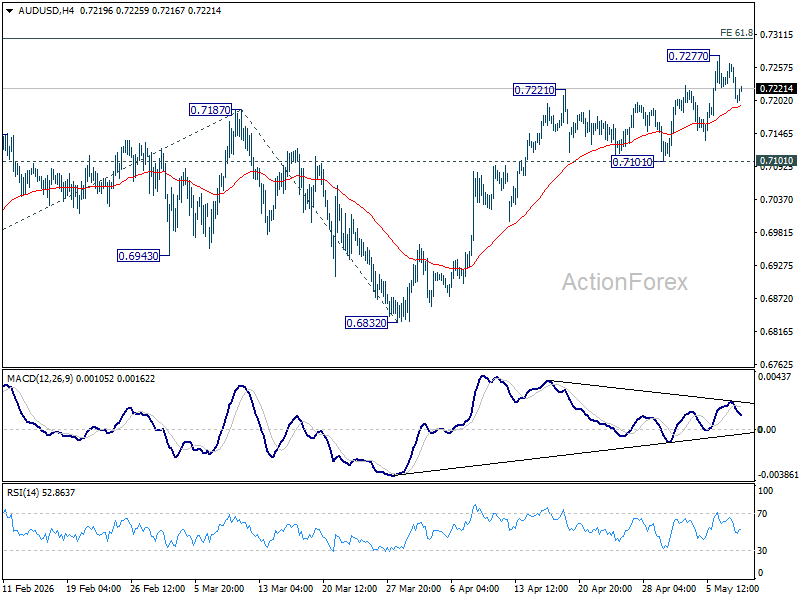
In the intricate dance of global currencies, the Australian Dollar (AUD) against the US Dollar (USD) often serves as a bellwether for broader economic sentiment, particularly concerning commodity markets and risk appetite. Currently, the AUD/USD pair finds itself at a critical juncture, with its intraday bias shifting to neutral following a recent retreat. This pause in momentum suggests a period of consolidation below the 0.7277 resistance level, setting the stage for what could be a significant move in either direction. For investors, traders, and economic observers alike, understanding the forces at play is paramount to anticipating the next chapter for the 'Aussie'.
The immediate technical outlook, as highlighted by financial analysts, points to a need for consolidation. The retreat from recent highs has tempered bullish enthusiasm, but the underlying expectation remains cautiously optimistic. A sustained rally is projected as long as the crucial support level of 0.7101 holds. Should this level prove resilient, the path could clear for an upward trajectory. Conversely, a decisive break above 0.7277 would signal a resumption of a larger bullish trend, potentially targeting the 61.8% Fibonacci projection of 0.7306, derived from the significant move between 0.6420 and 0.7187, with a base at 0.6832. These technical indicators, while precise, are merely reflections of the complex interplay of fundamental economic factors that truly drive currency valuations.
Global Economic Currents and Their Impact on AUD
The Australian Dollar is famously known as a 'commodity currency' due to Australia's vast exports of raw materials, including iron ore, coal, and agricultural products. This makes the AUD highly sensitive to global commodity prices and, by extension, the health of the global economy, particularly China, Australia's largest trading partner. A robust global manufacturing sector and strong demand from China typically bolster commodity prices, providing tailwinds for the AUD. Conversely, any slowdown in global growth or Chinese demand can quickly put pressure on the Aussie.
Recent global economic data has presented a mixed picture. While some major economies show signs of recovery, inflation concerns and the potential for tighter monetary policies from central banks, especially the US Federal Reserve, introduce an element of uncertainty. The US Dollar (USD), as the world's primary reserve currency, often strengthens during periods of global uncertainty or when the Federal Reserve signals a more hawkish stance, making it an attractive safe-haven asset. This dynamic creates a constant tug-of-war for the AUD/USD pair. When the Fed hints at interest rate hikes, the yield differential between US and Australian bonds can narrow or even reverse, making USD-denominated assets more appealing and potentially weakening the AUD.
The Reserve Bank of Australia's Stance and Domestic Factors
Beyond global dynamics, domestic economic conditions and the monetary policy decisions of the Reserve Bank of Australia (RBA) play a pivotal role. The RBA's stance on interest rates, inflation, and employment directly influences the attractiveness of holding Australian assets. If the RBA adopts a more hawkish tone, signaling potential rate hikes to combat inflation or acknowledging a stronger-than-expected economic recovery, it can provide significant support for the AUD. Conversely, a dovish RBA, prioritizing growth over inflation control, might see the AUD weaken.
Recent RBA communications have been carefully scrutinized for clues about their forward guidance. While the RBA has generally maintained a cautious approach, acknowledging global uncertainties, domestic inflation pressures and a strong labor market could eventually push them towards a more tightening cycle. Key domestic data points, such as: * Inflation reports (CPI) * Employment figures * Retail sales * Business confidence surveys
These are all crucial for traders and investors to monitor. Strong performance in these indicators can reinforce the RBA's confidence in the economy and potentially lead to a stronger AUD. Any unexpected weakness, however, could prompt a more dovish RBA, weighing on the currency.
Technical Levels and Future Projections
For short-term traders, understanding the daily pivot points and key resistance/support levels is essential. The current daily pivots are identified as: * S1 (Support 1): 0.7187 * P (Pivot Point): 0.7226 * R1 (Resistance 1): 0.7247
These levels act as psychological and technical barriers or floors for price action. The current retreat, as noted, suggests that the pair is consolidating below the 0.7277 mark. A break above this level is not just a technical event; it signifies a shift in market sentiment and potentially a renewed buying interest. The target of 0.7306, derived from Fibonacci projections, represents a significant technical milestone that, if achieved, would confirm a robust upward trend. Conversely, a failure to hold 0.7101 support could trigger a deeper correction, potentially testing lower Fibonacci retracement levels.
It's important to remember that technical analysis, while powerful, is not infallible. Geopolitical events, sudden shifts in commodity prices, or unexpected central bank announcements can quickly invalidate technical patterns. Therefore, a holistic approach combining both fundamental and technical analysis is always recommended.
The Road Ahead: Opportunities and Risks
The immediate future for AUD/USD appears to be one of cautious optimism, tempered by global uncertainties. The 0.7101 support level is the immediate line in the sand for bulls. As long as it holds, the prospect of a rally towards 0.7277 and potentially 0.7306 remains viable. However, the path will likely be characterized by volatility, influenced by upcoming economic data releases from both Australia and the United States, as well as broader shifts in global risk sentiment.
Investors should pay close attention to: * Commodity price trends, especially iron ore and oil. * China's economic indicators and policy decisions. * US Federal Reserve's monetary policy outlook and any hawkish signals. * RBA's forward guidance and domestic economic reports.
The AUD/USD pair is a dynamic reflection of global economic health and monetary policy divergence. While the current neutral bias suggests a temporary lull, the underlying technical and fundamental factors point towards a potential for significant movement. For those tracking the Aussie, vigilance and a comprehensive understanding of these interconnected forces will be key to navigating the opportunities and risks that lie ahead in this fascinating currency pair.
Stay Informed
Get the world's most important stories delivered to your inbox.
No spam, unsubscribe anytime.
Comments
No comments yet. Be the first to share your thoughts!