DFAT's Legal Quandary: Australia's Early Concerns Over US-Israel Strikes on Iran Unveiled
Newly revealed Australian government documents expose initial fears within the Department of Foreign Affairs and Trade (DFAT) regarding the legality of US-Israel airstrikes on Iran. These confidential talking points, prepared for ministers, underscore a significant diplomatic and legal challenge for allies navigating the volatile Middle East. The revelations highlight the complex international law implications and the potential for a broader regional conflict, prompting questions about accountability and the future of international relations.
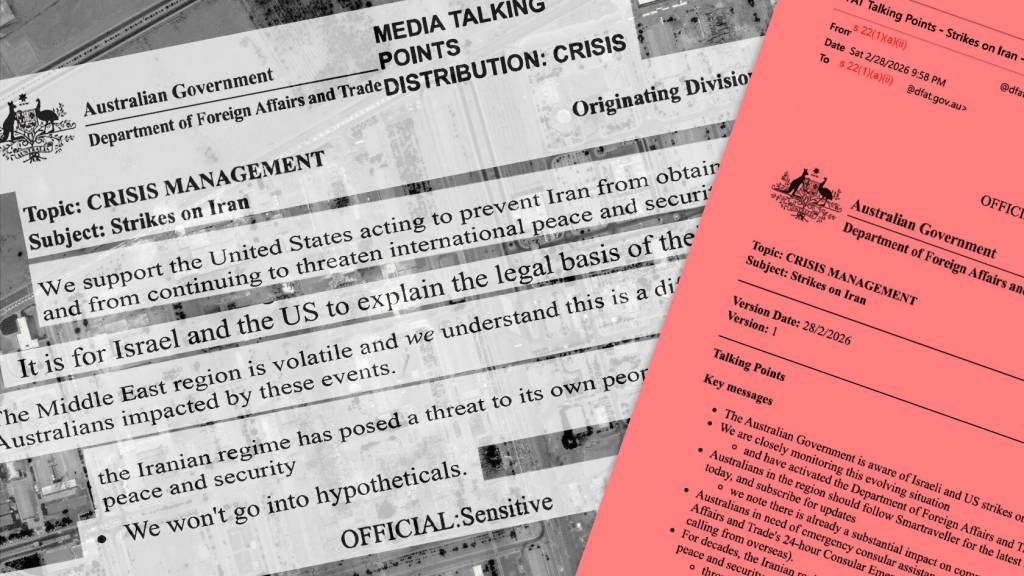
The diplomatic corridors of Canberra buzzed with quiet apprehension as the Department of Foreign Affairs and Trade (DFAT) grappled with the immediate aftermath of reported US-Israel airstrikes on Iran. Confidential talking points, swiftly prepared for government ministers, reveal a profound and immediate concern: the legality of these strikes under international law. This internal apprehension, unearthed through documents obtained by Crikey, offers a rare glimpse into the delicate tightrope walk allies must perform when geopolitical tensions escalate, and the specter of conflict looms large over the Middle East.
At the heart of DFAT's concern was the anticipated barrage of questions from media and the public regarding the justification for such military actions. The very act of preparing these preemptive responses signals a recognition of the significant legal and ethical ambiguities inherent in unilateral military interventions, especially in a region already fraught with historical grievances and complex power dynamics. This is not merely an academic exercise; it touches upon the foundational principles of state sovereignty, the prohibition on the use of force, and the collective security framework enshrined in the United Nations Charter.
The Shadow of International Law: Justification and Precedent
International law, particularly the UN Charter, generally prohibits the use of force by one state against another, with narrow exceptions such as self-defense (Article 51) or authorization by the UN Security Council. The source material explicitly states that DFAT anticipated questions about the "legality of the strikes." This suggests that the immediate justification provided by the US and Israel – likely self-defense against perceived Iranian threats or proxies – was not universally accepted or was seen as potentially contentious. For Australia, a staunch advocate of the rules-based international order, any action that appears to circumvent or stretch these legal boundaries poses a significant diplomatic dilemma.
Historically, the international community has struggled with the concept of preemptive self-defense, especially when the threat is not imminent or directly observable. The 2003 invasion of Iraq, justified by claims of weapons of mass destruction that later proved false, remains a potent cautionary tale regarding the perils of unilateral military action based on contested intelligence. DFAT's internal discussions likely weighed these historical precedents, understanding that any perceived deviation from established international legal norms could set dangerous precedents and further destabilize an already volatile region. The department's focus on crafting talking points underscores the need to articulate a coherent and legally defensible position, even if the underlying actions were undertaken by close allies.
Geopolitical Chessboard: Iran, US, Israel, and Regional Stability
The strikes on Iran, whether attributed to the US, Israel, or both, occur within a deeply intricate geopolitical landscape. Iran's nuclear program, its support for various non-state actors across the Middle East (such as Hezbollah in Lebanon, Hamas in Gaza, and Houthi rebels in Yemen), and its adversarial relationship with Israel and Saudi Arabia have long been sources of regional instability. The United States, a key ally of Israel, has maintained a robust military presence in the region and has often taken a firm stance against Iranian expansionism.
Israel, viewing Iran as an existential threat, has a documented history of conducting covert and overt operations to counter Iranian influence and capabilities. These actions often operate in a grey zone of international law, with Israel frequently citing self-defense against Iranian-backed aggression. The specific nature of the strikes mentioned in the source material – whether they targeted nuclear facilities, military installations, or proxy forces – would significantly influence their legal interpretation. However, the very fact that DFAT flagged legal concerns indicates that the actions were likely perceived as aggressive rather than purely defensive, or at least highly ambiguous in their justification.
For Australia, navigating this complex web means balancing its alliance commitments with its commitment to international law. Publicly condemning or even questioning the actions of allies can strain diplomatic ties, yet remaining silent on potential breaches of international law can undermine Australia's own credibility as a proponent of a rules-based order. This internal conflict is precisely what the DFAT talking points aimed to manage, providing ministers with a framework to address public and media inquiries without alienating key partners or compromising Australia's principles.
Implications for Australian Foreign Policy and Beyond
The DFAT revelations are significant for several reasons. Firstly, they highlight the internal scrutiny that major international events undergo within foreign policy establishments, even among close allies. This isn't about blind allegiance but about a careful assessment of risks, legalities, and strategic implications. Secondly, they underscore the fragility of peace in the Middle East, where even limited military actions can trigger a cascade of reactions, potentially leading to wider conflict. The memory of previous regional wars, such as the Iraq-Iran War or the Gulf Wars, serves as a stark reminder of the devastating human and economic costs of unchecked escalation.
Furthermore, these concerns reflect a broader international anxiety about the erosion of international legal norms. In an era marked by increasing geopolitical competition and the rise of revisionist powers, the consistent application and respect for international law are more critical than ever. When powerful nations act unilaterally, it creates a precedent that can be exploited by others, leading to a more chaotic and unpredictable global environment. Australia, as a middle power with significant stakes in global stability, has a vested interest in upholding these norms.
The Path Forward: Diplomacy, De-escalation, and Dialogue
The challenges revealed by the DFAT documents are enduring. The international community, led by institutions like the United Nations, must redouble efforts towards diplomatic solutions and de-escalation. This includes: * Robust dialogue between all regional actors, including Iran, to address security concerns and build confidence. * Strict adherence to international law, ensuring that any use of force is demonstrably legitimate and proportionate. * Strengthening multilateral institutions to provide platforms for conflict resolution and prevent unilateral actions. * Addressing the root causes of conflict, such as economic disparities, political grievances, and sectarian tensions, which often fuel proxy wars and regional instability.
The DFAT's initial legal fears serve as a stark reminder that military solutions, while sometimes perceived as immediate, often carry profound and long-lasting legal, ethical, and geopolitical consequences. For Australia and its allies, the path forward must prioritize a commitment to international law, robust diplomacy, and a collective effort to prevent the Middle East from spiraling into further conflict. The world watches, hoping that reason and respect for established norms will prevail over the dangerous allure of unilateral force, ensuring a more stable and predictable future for all nations.
Stay Informed
Get the world's most important stories delivered to your inbox.
No spam, unsubscribe anytime.
Comments
No comments yet. Be the first to share your thoughts!