London on Edge: Thousands of Police Deployed Amidst Rival Protests
London braced for a day of heightened tension as over 4,000 police officers were deployed to manage rival demonstrations. A far-right march led by Tommy Robinson clashed with a large pro-Palestinian protest, prompting one of the Metropolitan Police's most significant operations in recent years. The capital's streets became a crucible of conflicting ideologies, testing public order and freedom of expression.
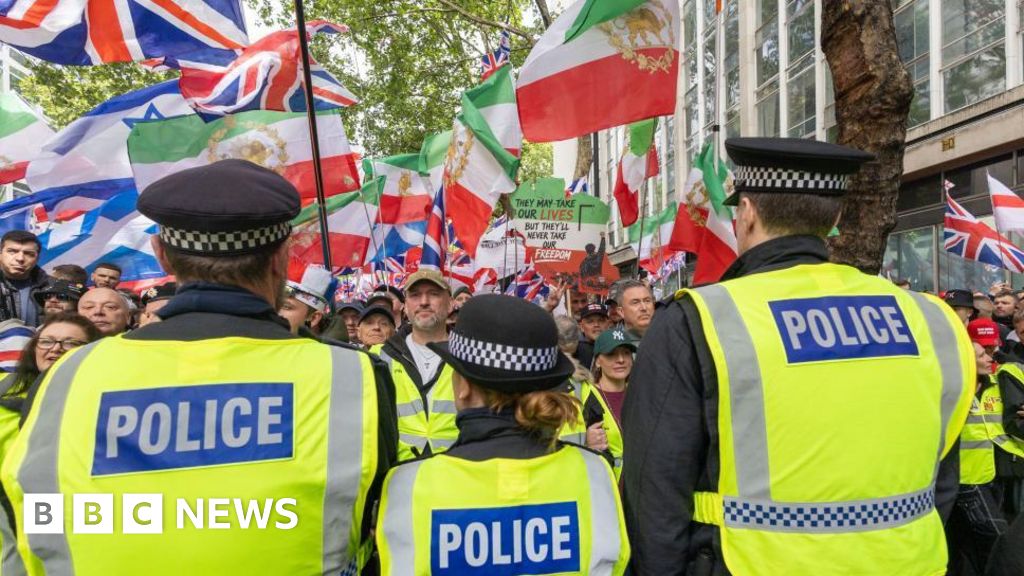
London, a city synonymous with democratic freedoms and diverse public discourse, found itself at a critical juncture as over 4,000 police officers descended upon its streets. This massive deployment, described by the Metropolitan Police as one of the most significant operations in recent years, was necessitated by the convergence of two ideologically opposed demonstrations: a far-right march spearheaded by Tommy Robinson and a large-scale pro-Palestinian protest. The capital became a tense theatre where the right to protest met the imperative of maintaining public order, casting a stark light on the deep societal divisions simmering beneath the surface.
The sheer scale of the police presence underscores the gravity of the situation. Officers were equipped with a formidable array of resources, including drones for aerial surveillance, police horses and dogs for crowd control, and armoured vehicles on standby, ready to intervene if tensions escalated beyond manageable levels. This proactive and highly visible strategy aimed to prevent direct confrontations between the rival groups, a scenario that has, in the past, led to widespread disorder and violence. The Met's intricate planning included establishing cordons and designated routes, effectively creating a buffer zone to separate the demonstrators and minimize flashpoints. This operation was not merely about crowd management; it was a delicate balancing act of upholding civil liberties while safeguarding public safety.
A City Divided: The Roots of Discontent
The backdrop to these protests is a complex tapestry of geopolitical events and domestic socio-political currents. The pro-Palestinian demonstrations have been a regular feature in London and other major Western cities since the escalation of the conflict in the Middle East. These protests, often drawing tens of thousands, express solidarity with Palestinians, condemn Israeli actions, and call for a ceasefire. They are fueled by deeply held humanitarian concerns, historical grievances, and a sense of moral urgency, resonating strongly within London's diverse communities.
Conversely, the far-right march led by Tommy Robinson, a controversial figure known for his anti-Islam activism, represents a different facet of public sentiment. Robinson's supporters often articulate concerns about national identity, immigration, and perceived threats to Western values. His rallies frequently attract individuals who feel marginalized or unheard by mainstream politics, and who are often critical of the pro-Palestinian movement, sometimes viewing it as anti-Semitic or a threat to social cohesion. The timing of his protest, coinciding with a major pro-Palestinian event, was seen by many as deliberately provocative, designed to maximize confrontation and media attention.
This clash of narratives and ideologies highlights a broader societal struggle within the UK and across Europe. The polarization of political discourse, exacerbated by social media and global events, has made it increasingly challenging for authorities to manage public assemblies without significant resource allocation. The right to protest is a cornerstone of democracy, but when these rights are exercised in a manner that threatens public safety or incites hatred, the state faces an unenviable dilemma.
The Metropolitan Police's Strategic Response
The Metropolitan Police's approach to this dual protest scenario was meticulously planned, drawing on lessons from previous large-scale public order operations. The deployment of over 4,000 officers signifies a commitment to overwhelming presence as a deterrent. This number represents a substantial portion of the Met's operational capacity, highlighting the perceived risk level. The use of specialized units, including mounted police and dog handlers, is standard practice for dynamic crowd control, offering both mobility and a psychological deterrent.
Furthermore, the Met's use of drones provides crucial real-time intelligence, allowing commanders to monitor crowd movements, identify potential troublemakers, and direct resources effectively. The armoured vehicles on standby serve as a last resort, signaling the police's readiness to contain severe public disorder should it erupt. This multi-faceted strategy aims to achieve several objectives: to facilitate peaceful protest, to prevent inter-group violence, to protect critical infrastructure, and to minimize disruption to the wider public.
However, such a massive police presence also raises questions about resource allocation and the cost to the taxpayer. Public order policing operations of this magnitude are incredibly expensive, diverting resources from other areas of law enforcement. There's also the delicate balance between maintaining order and avoiding the perception of an overly militarized response, which can sometimes inflame tensions rather than diffuse them. The Met's challenge is to project authority without appearing oppressive, a task made harder by the highly charged nature of the protests.
Historical Context and Implications
London has a rich history of protests, from the Suffragettes to anti-war movements, and more recently, environmental activism. The city has often been a global stage for expressing dissent and advocating for change. However, the current climate, characterized by deep ideological divides and the weaponization of public space, presents unique challenges. The rise of social media has transformed how protests are organized and amplified, often leading to faster mobilization and greater potential for misinformation.
This specific operation draws parallels with other significant public order events, such as the 2011 London riots or major political demonstrations. Each event provides valuable data and experience for police forces worldwide. The implications extend beyond immediate public safety; they touch upon the health of democratic discourse, the limits of free speech, and the role of the state in managing societal conflict. When rival groups with fundamentally opposing views choose to demonstrate in close proximity, it tests the very fabric of social cohesion.
For residents and businesses in London, these events translate into disruption and anxiety. Road closures, increased security, and the potential for unrest can significantly impact daily life and economic activity. The city's reputation as a safe and open global hub is also implicitly on trial, as images of heavily policed streets are broadcast internationally.
Looking Ahead: Navigating a Fractured Landscape
The London protests serve as a potent reminder of the fragility of public order in an increasingly polarized world. While the immediate objective of preventing widespread violence may have been met by the overwhelming police presence, the underlying issues that fuel these demonstrations remain unresolved. The challenge for policymakers, community leaders, and law enforcement is not merely to manage protests but to address the root causes of division and discontent.
Moving forward, societies must grapple with how to foster constructive dialogue across ideological divides, protect freedom of expression without enabling hate speech, and ensure that public spaces remain accessible for all, not just those willing to brave a heavily policed environment. The events in London are a microcosm of global tensions, reflecting a world grappling with identity, justice, and the very definition of shared values. The successful management of these protests, while commendable from a public order perspective, is but a temporary calm in a storm that shows no signs of abating. The true test lies in building bridges where chasms currently exist, a task far more complex than any police operation.
Ultimately, the deployment of thousands of officers in London is a stark symbol of the times – a testament to the enduring power of protest, the deep divisions within modern societies, and the constant, often unseen, effort required to maintain peace and order in a world increasingly on edge.
Stay Informed
Get the world's most important stories delivered to your inbox.
No spam, unsubscribe anytime.
Comments
No comments yet. Be the first to share your thoughts!