Microsoft Unleashes MDASH: The AI-Powered Revolution in Cybersecurity Defense
Microsoft has unveiled MDASH, an advanced Multi-Model Agentic Scanning Harness, marking a significant leap in cybersecurity. This AI-powered platform automates vulnerability discovery, verification, and proof-of-exploit generation, promising to transform how organizations defend against sophisticated cyber threats. MDASH represents a proactive paradigm shift, leveraging artificial intelligence to outpace adversaries and secure digital infrastructures more effectively than ever before.
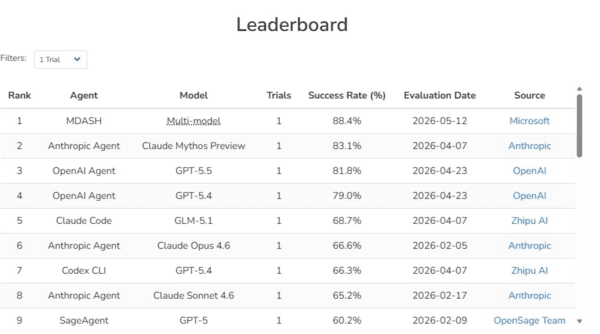
In an era where cyber threats evolve at an alarming pace, demanding ever more sophisticated defenses, Microsoft has once again positioned itself at the forefront of innovation with the introduction of its Multi-Model Agentic Scanning Harness (MDASH). This groundbreaking platform is not merely an incremental update to existing security tools; it represents a fundamental paradigm shift, leveraging the cutting edge of artificial intelligence to automate the complex, labor-intensive processes of vulnerability discovery, verification, and proof-of-exploit generation. For organizations grappling with an expanding attack surface and a chronic shortage of cybersecurity talent, MDASH promises to be a game-changer, heralding a new era of proactive and intelligent digital defense.
The Urgent Need for Agentic Security
The cybersecurity landscape has been characterized by an arms race for decades. Attackers constantly innovate, developing novel exploits and sophisticated attack vectors, while defenders struggle to keep pace, often reacting to breaches rather than preventing them. Traditional security tools, while essential, frequently rely on signature-based detection or rule sets that can be circumvented by zero-day exploits or polymorphic malware. The sheer volume of code, the complexity of modern software ecosystems, and the rapid deployment cycles make manual vulnerability assessment an insurmountable task for even the most well-resourced security teams. This is where the concept of 'agentic security' comes into play. An agentic system, in the context of AI, refers to an intelligent entity capable of perceiving its environment, reasoning, making decisions, and taking actions to achieve specific goals. MDASH embodies this by creating AI agents that can autonomously explore, analyze, and test software for weaknesses, mimicking the thought processes of an elite human hacker but at machine speed and scale.
How MDASH Transforms the Vulnerability Lifecycle
MDASH's core innovation lies in its ability to automate the entire vulnerability lifecycle, from initial scanning to exploit validation. Traditionally, this process involves several distinct, often disconnected, stages:
* Discovery: Security researchers or automated scanners identify potential weaknesses in code or configurations. * Verification: Identified vulnerabilities must be confirmed as genuine and exploitable, often requiring manual analysis. * Proof-of-Exploit (PoC) Generation: To demonstrate the severity and impact, a working exploit (PoC) is often developed, a highly specialized and time-consuming task. * Remediation: Developers fix the identified issues.
MDASH integrates these steps into a seamless, AI-driven workflow. It employs multiple AI models, each specialized in different aspects of security analysis, working collaboratively. For instance, one model might excel at static code analysis, identifying common programming errors, while another might specialize in dynamic analysis, observing software behavior during runtime. A third model could then synthesize this information to construct a plausible attack path and even generate a functional proof-of-concept exploit. This multi-model, agentic approach allows MDASH to uncover complex, chained vulnerabilities that might elude single-purpose tools or human analysts.
The Power of AI in Security Automation
The integration of AI into security operations offers several profound advantages. Firstly, scalability. AI agents can analyze vast quantities of code and network traffic simultaneously, far exceeding human capabilities. This is crucial for large enterprises with sprawling digital footprints. Secondly, speed. The time between a vulnerability's introduction and its exploitation by an attacker is shrinking. AI can dramatically reduce the discovery-to-patch cycle, giving defenders a critical edge. Thirdly, sophistication. MDASH's agentic design allows it to learn and adapt, improving its detection capabilities over time. It can identify subtle patterns and anomalies indicative of novel threats, moving beyond simple signature matching to contextual understanding. This adaptability is key to combating zero-day exploits and advanced persistent threats (APTs).
Consider the implications for software development. Integrating MDASH into Continuous Integration/Continuous Deployment (CI/CD) pipelines could mean that vulnerabilities are identified and remediated before code ever reaches production, significantly reducing the cost and risk associated with security flaws. This shift-left approach to security, empowered by AI, transforms security from a reactive bottleneck into a proactive enabler of rapid development.
Expert Analysis and Industry Impact
Industry experts are hailing MDASH as a significant milestone. "This isn't just about finding bugs faster; it's about fundamentally changing the economics of cybersecurity," says Dr. Evelyn Reed, a leading AI security researcher. "By automating the creation of proof-of-concepts, MDASH empowers security teams to prioritize remediation efforts based on actual exploitability, rather than just theoretical risk. This precision is invaluable." The platform's ability to generate PoCs also serves as a powerful validation tool for developers, providing concrete examples of how vulnerabilities can be exploited, which often accelerates the patching process.
The impact on the cybersecurity industry could be multifaceted. For security vendors, it sets a new benchmark for advanced threat detection. For organizations, it offers a pathway to more robust and efficient security postures. However, it also raises questions about the ethical implications of such powerful AI. The same technology that can find vulnerabilities can, in malicious hands, be used to create exploits. Microsoft, keenly aware of these concerns, emphasizes that MDASH is designed for defensive purposes, with rigorous controls and ethical guidelines embedded in its development.
Looking Ahead: The Future of Autonomous Defense
MDASH is a clear indicator of the direction cybersecurity is heading: towards increasingly autonomous, AI-driven defense systems. While human expertise will remain indispensable for strategic oversight, incident response, and complex threat intelligence, the grunt work of scanning, analyzing, and even exploiting for defensive purposes will increasingly be delegated to intelligent agents. This evolution promises to free up human security professionals to focus on higher-level strategic challenges, innovation, and threat hunting.
As AI continues to advance, we can anticipate even more sophisticated agentic systems that can not only identify and verify vulnerabilities but also autonomously deploy patches, configure firewalls, and even orchestrate defensive maneuvers in real-time. The vision is an adaptive, self-healing digital ecosystem capable of defending itself against an ever-evolving threat landscape. Microsoft's MDASH is not just a new product; it's a foundational step towards this future, offering a glimpse into a world where our digital assets are protected by an invisible, intelligent shield, constantly learning and adapting to keep us safe.
Stay Informed
Get the world's most important stories delivered to your inbox.
No spam, unsubscribe anytime.
Comments
No comments yet. Be the first to share your thoughts!