Abbas Pledges Reforms, Elections Amidst Fatah's Critical Juncture
Palestinian President Mahmoud Abbas has vowed to push forward with significant reforms within the Palestinian Authority and committed to holding long-delayed presidential and parliamentary elections. Speaking at a crucial Fatah conference in Ramallah, Abbas emphasized the need for internal renewal and a unified national vision. This pivotal moment comes as Fatah seeks to revitalize its leadership and address growing internal and external pressures, shaping the future of Palestinian governance and the broader peace process.
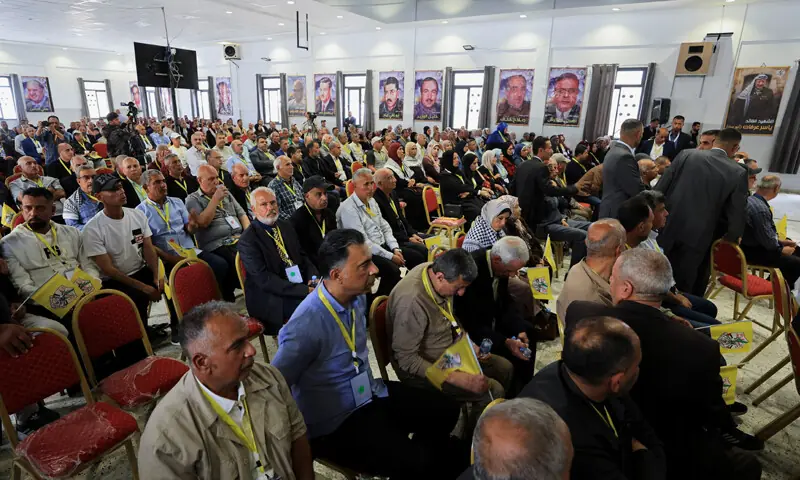
RAMALLAH – In a moment charged with both historical weight and future uncertainty, Palestinian President Mahmoud Abbas stood before the Fatah movement's eighth general conference in Ramallah, delivering a resolute pledge to enact sweeping reforms within the Palestinian Authority (PA) and to finally hold long-overdue presidential and parliamentary elections. The three-day event, a critical assembly for the ruling Fatah party, is set to elect a new central committee, signaling a potential generational shift in leadership and a renewed commitment to democratic principles amidst a landscape fraught with political stagnation and public disillusionment.
Abbas, 88, whose tenure as president officially ended in 2009 but has continued due to the absence of elections, acknowledged the profound challenges facing the Palestinian people. His address, delivered to hundreds of delegates, underscored the urgent need for internal cohesion and a strengthened national project. The promise of elections, last held for the presidency in 2005 and for parliament in 2006, offers a glimmer of hope for democratic renewal, even as the complexities of holding such polls across the West Bank, Gaza, and East Jerusalem remain formidable obstacles.
The Imperative for Reform and Renewal
The call for reforms is not new, but its emphasis at this conference reflects a growing recognition within Fatah that the status quo is unsustainable. The Palestinian Authority, established in 1994 as part of the Oslo Accords, has faced persistent criticism regarding its governance, transparency, and effectiveness. International donors and Palestinian citizens alike have increasingly demanded greater accountability and a more representative political system. Abbas's commitment to reform suggests an acknowledgment of these pressures, aiming to bolster the PA's legitimacy and operational capacity.
Reforms are expected to target several key areas: governance structures, to enhance efficiency and reduce bureaucracy; financial management, to improve transparency and combat corruption; and security sector oversight, to ensure accountability and adherence to human rights standards. The success of these reforms will be crucial for regaining public trust and demonstrating Fatah's capacity to lead a modern, democratic state-in-waiting. The election of a new Central Committee is a significant step in this direction, as it will likely bring fresh perspectives and potentially younger leaders into the party's highest echelons, tasked with implementing these changes.
The Elusive Promise of Elections
Presidential and parliamentary elections have been postponed multiple times since 2006, primarily due to the intractable division between Fatah, which governs the West Bank, and Hamas, which controls the Gaza Strip. The last scheduled elections in 2021 were canceled by Abbas, citing Israel's refusal to allow voting in East Jerusalem. This decision drew widespread condemnation and further deepened the sense of political paralysis among Palestinians.
Abbas's renewed pledge to hold elections, therefore, carries significant weight. For elections to be truly democratic and inclusive, several preconditions must be met. Firstly, an agreement between Fatah and Hamas on the electoral process is paramount. Without a unified approach, the legitimacy of any election held only in the West Bank would be questioned. Secondly, Israel's cooperation, particularly regarding voting in East Jerusalem, is essential. Historically, Israel has viewed Palestinian elections in Jerusalem as a challenge to its sovereignty over the city.
Furthermore, the logistical and security challenges of organizing elections across fragmented territories, under military occupation in the West Bank, and under Hamas rule in Gaza, are immense. The international community, including the United States and the European Union, has consistently called for Palestinian elections, viewing them as vital for democratic development and a renewed peace process. Their support, both political and financial, would be critical for any successful electoral endeavor.
Fatah's Internal Dynamics and Future Direction
The Fatah conference is not just about external pledges; it's a vital internal reckoning for the movement itself. Founded in the late 1950s, Fatah has historically been the dominant force in Palestinian politics, leading the Palestine Liberation Organization (PLO) and the struggle for statehood. However, its influence has waned over the years, challenged by the rise of Hamas and internal divisions. The conference provides an opportunity for Fatah to reassert its relevance and redefine its vision for the future.
The election of a new Central Committee, the party's highest decision-making body, is a key focus. Observers are keenly watching for signs of a generational transition, with potential new faces emerging to challenge the old guard. This internal rejuvenation is seen as crucial for Fatah to reconnect with a younger generation of Palestinians who are increasingly disillusioned with traditional political structures and leaders. The composition of the new committee will indicate the direction Fatah intends to take on critical issues such as the peace process, relations with Israel, and internal governance.
Implications for Regional Stability and the Peace Process
Abbas's pronouncements have significant implications beyond internal Palestinian politics. A revitalized Palestinian Authority, backed by a democratic mandate, could potentially strengthen the Palestinian negotiating position in any future peace talks with Israel. Conversely, continued political stagnation and internal divisions only serve to weaken the Palestinian cause and perpetuate the cycle of conflict.
The international community will be closely observing the outcomes of the Fatah conference and the subsequent implementation of Abbas's pledges. A credible commitment to elections and reforms could unlock greater international support and investment, fostering stability in a volatile region. However, failure to deliver on these promises could further entrench disillusionment, potentially leading to increased instability and radicalization.
The path forward for the Palestinian Authority and the Fatah movement is fraught with challenges, but Abbas's pledges at the Ramallah conference represent a critical juncture. The world watches to see if these promises will translate into tangible progress towards a more democratic, unified, and self-determined Palestinian future, or if they will remain yet another unfulfilled commitment in a long history of aspirations.
Stay Informed
Get the world's most important stories delivered to your inbox.
No spam, unsubscribe anytime.
Comments
No comments yet. Be the first to share your thoughts!