ASRock's HUDIMM: A Game Changer for DDR5 Memory Pricing on Intel Boards?
ASRock is tackling the high cost of DDR5 memory with its innovative HUDIMM technology, which features a single sub-channel per module. This approach could significantly lower manufacturing costs and make high-capacity DDR5 more accessible for Intel users. While broader test data is pending, ASRock's initial findings suggest a promising future for more affordable, efficient memory solutions.
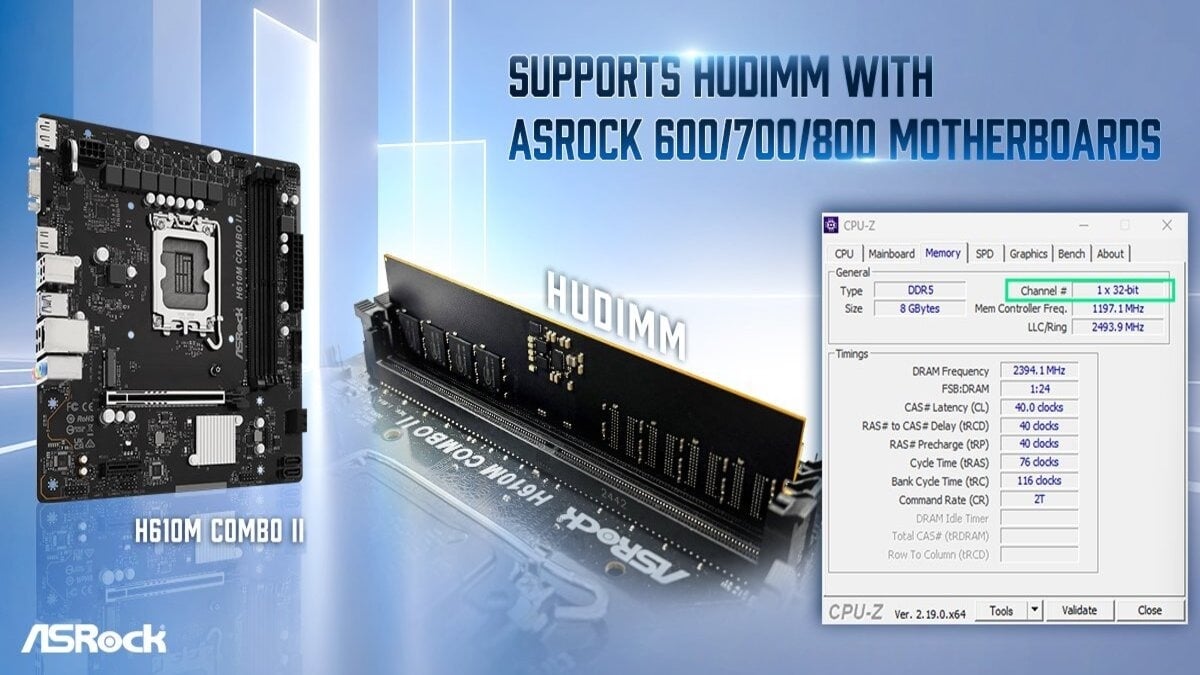
The relentless march of technological progress often comes with a steep price tag, and few components illustrate this better than DDR5 memory. For PC builders and enthusiasts, the transition to this next-generation RAM has been fraught with sticker shock, particularly for those embracing Intel’s latest platforms. However, a potential beacon of hope has emerged from an unexpected quarter: ASRock, the Taiwanese motherboard manufacturer, is pioneering a novel approach with its HUDIMM (Half-Unbuffered DIMM) technology, promising to alleviate the financial burden of high-performance memory. This innovation, which features a single sub-channel per DDR5 module, could fundamentally reshape the memory market, making cutting-edge performance more accessible to the masses.
The High Cost of Cutting-Edge Memory: A Market Overview
To understand the significance of ASRock’s HUDIMM, one must first grasp the current landscape of DDR5 memory. When DDR5 was introduced, it brought with it substantial architectural changes designed for higher bandwidth and efficiency. Unlike DDR4, which used a single 64-bit data channel, DDR5 modules feature two independent 32-bit sub-channels (plus 8-bit ECC for each, totaling 40 bits per sub-channel). This dual-sub-channel design, while boosting performance, also necessitated a more complex PCB layout and a greater number of components, including two PMICs (Power Management Integrated Circuits) and two SPD Hubs (Serial Presence Detect Hubs) per module. These additional components, coupled with the inherent complexities of new technology, contributed significantly to higher manufacturing costs and, consequently, higher retail prices.
For consumers, especially those building high-end Intel systems that exclusively support DDR5, the cost of populating all four DIMM slots with high-capacity modules has been prohibitive. A 64GB (2x32GB) kit of DDR5 can easily cost hundreds of dollars, often exceeding the price of the CPU itself. This economic barrier has slowed the widespread adoption of DDR5, forcing many to either compromise on capacity or stick with older, less powerful platforms. The market has been crying out for a cost-efficient alternative, and ASRock’s HUDIMM appears to be a direct response to this demand, aiming to democratize access to high-performance computing.
ASRock's HUDIMM: Engineering Simplicity for Cost Reduction
ASRock’s HUDIMM technology offers a clever solution to the cost problem by rethinking the fundamental design of DDR5 modules. The core innovation lies in reducing the number of sub-channels from two to one per DIMM. This seemingly minor alteration has profound implications for manufacturing costs. By eliminating one 32-bit sub-channel, ASRock can remove one PMIC and one SPD Hub from each module. These components, while small, are crucial and contribute significantly to the overall bill of materials. Furthermore, a single sub-channel design simplifies the PCB layout, potentially allowing for less complex and thus cheaper manufacturing processes.
The concept of a “Half-Unbuffered DIMM” is intriguing. While standard DDR5 UDIMMs (Unbuffered DIMMs) feature two sub-channels, HUDIMM effectively halves this. The crucial aspect is how this interacts with the motherboard. ASRock’s motherboards are designed to recognize and utilize these single-sub-channel modules. This means that a motherboard with four DIMM slots, when populated with HUDIMM modules, could effectively function as if it were using two dual-sub-channel modules, but with the cost benefits of simpler single-sub-channel designs. The company has demonstrated this with a Z790 motherboard, showcasing compatibility and functionality.
Performance Implications and Market Strategy
Naturally, the question arises: what are the performance implications of halving the sub-channels? While ASRock has not yet released extensive, third-party validated test data, their initial demonstrations suggest that the performance impact might be less severe than one might assume, especially in configurations where multiple HUDIMM modules are used. For instance, populating two DIMM slots with HUDIMM modules would still provide two active 32-bit sub-channels to the memory controller, similar to a single standard UDIMM. If all four slots are populated with HUDIMM, the system would effectively have four active 32-bit sub-channels, potentially offering competitive performance while drastically reducing the per-module cost.
ASRock’s strategy appears to be multifaceted:
* Cost Reduction: The primary goal is to lower the barrier to entry for DDR5, making high-capacity configurations more affordable. * Flexibility: Offering HUDIMM alongside traditional UDIMM modules could give consumers more choices, allowing them to mix and match based on budget and performance needs. Imagine a scenario where a user could start with two HUDIMM modules and later upgrade with more, or even combine them with standard UDIMMs if the motherboard supports it. * Market Differentiation: In a highly competitive motherboard market, innovation like HUDIMM can be a significant differentiator, attracting budget-conscious consumers and those looking for smart engineering solutions.
This move by ASRock is reminiscent of previous industry efforts to optimize costs without sacrificing too much performance. It signals a broader trend where manufacturers are looking beyond raw speed and focusing on the overall value proposition for the end-user. The success of HUDIMM will largely depend on its widespread adoption by other memory module manufacturers and its acceptance by the broader PC enthusiast community.
The Future of DDR5 and Beyond: A Forward-Looking Perspective
The introduction of ASRock’s HUDIMM technology could mark a pivotal moment in the evolution of DDR5 memory. If successful, it could spur a significant drop in DDR5 prices, accelerating its adoption across mainstream and enthusiast segments. This would not only benefit consumers but also potentially push the industry to explore further cost-optimization strategies for future memory standards.
However, challenges remain. Broader industry support, comprehensive performance benchmarks from independent reviewers, and clear communication from ASRock regarding compatibility and potential limitations will be crucial for HUDIMM to gain traction. Will other motherboard manufacturers follow suit? Will memory module makers embrace this new standard? These questions will define the trajectory of this promising innovation.
In an era where every dollar counts, ASRock’s HUDIMM represents a thoughtful engineering response to a pressing market need. It’s a testament to the idea that innovation isn't always about pushing the absolute limits of performance, but sometimes about making advanced technology more accessible and affordable. As the PC hardware market continues to evolve, solutions like HUDIMM will be vital in ensuring that cutting-edge technology remains within reach for a wider audience, fostering innovation and growth across the entire ecosystem. The coming months will reveal whether this bold move by ASRock truly becomes the game-changer it promises to be, potentially ushering in a new era of more affordable, high-capacity DDR5 memory for Intel platforms and beyond.
Stay Informed
Get the world's most important stories delivered to your inbox.
No spam, unsubscribe anytime.
Comments
No comments yet. Be the first to share your thoughts!