The 'Axis of Upheaval': How Geopolitical Shifts Challenge the US-Led World Order
A new geopolitical alignment, dubbed the 'CRINKs' (China, Russia, Iran, North Korea), is aggressively challenging the established US-led global order. Fueled by a shared determination and perceived Western vulnerabilities, this axis seeks to reshape international dynamics, raising concerns about future stability. This article explores the origins, motivations, and potential implications of this burgeoning alliance, particularly in light of recent political shifts.
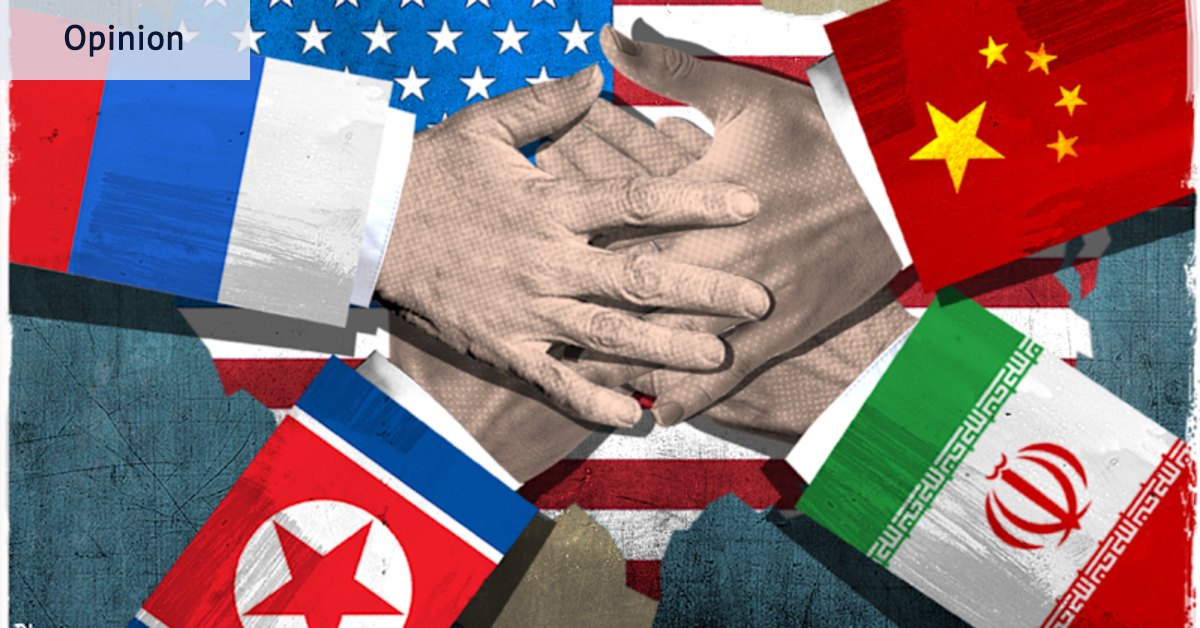
In an increasingly complex and multipolar world, a formidable new alignment of powers is emerging, one that directly confronts the long-standing US-led global order. Dubbed the 'CRINKs' – an acronym for China, Russia, Iran, and North Korea – this informal but potent alliance is characterized by a shared determination to challenge Western hegemony and reshape international norms. Their rise, and the perceived emboldening of their ambitions, marks a critical juncture in global geopolitics, demanding urgent attention and strategic foresight from policymakers worldwide.
For decades, the international system has largely operated under a framework established after World War II, dominated by institutions like the United Nations, NATO, and the Bretton Woods financial system, all heavily influenced by the United States and its Western allies. This order, often described as liberal and rules-based, has underpinned relative global stability and economic integration. However, the CRINKs perceive this order as an instrument of Western dominance, designed to maintain their power and suppress alternative models of governance and development. Their collective actions, ranging from military cooperation and economic partnerships to cyber warfare and disinformation campaigns, signal a concerted effort to dismantle or at least significantly alter this status quo.
The Genesis of a Challenge: Shared Grievances and Strategic Convergence
The roots of the CRINKs' convergence lie in a complex tapestry of historical grievances, ideological opposition, and strategic imperatives. Each nation, in its own right, harbors deep-seated resentments towards what it views as Western interference in its internal affairs or a denial of its legitimate regional and global aspirations. China, with its rapidly expanding economic and military might, seeks to reclaim its historical position as a central global power, challenging US influence in the Indo-Pacific and beyond. Russia, feeling historically marginalized and threatened by NATO expansion, aims to restore its sphere of influence and diminish Western power in Eastern Europe and the Middle East.
Iran, a revolutionary Islamic republic, has long been at odds with the US and its allies over its nuclear program, regional ambitions, and human rights record, viewing the West as an existential threat. North Korea, a reclusive and heavily militarized state, uses its nuclear arsenal as a deterrent against perceived US aggression and a means to secure its regime's survival. These individual narratives converge into a shared anti-Western sentiment, creating fertile ground for cooperation. Their strategic convergence is not necessarily based on a unified ideology, but rather on a pragmatic alignment of interests: to weaken the US and its allies, diversify their international partnerships, and create a more multipolar world where their respective national interests can be pursued with greater autonomy.
The Role of Perceived Western Weakness and Political Volatility
A significant factor contributing to the emboldening of the CRINKs is their perception of Western weakness and internal divisions. The tumultuous political landscape in the United States, particularly the prospect of a return to 'America First' isolationist policies, sends signals of unpredictability and potential disengagement. Such a shift could lead to a weakening of alliances, a reduction in global leadership, and a more fragmented international response to crises. This perceived vacuum or inconsistency in Western leadership provides an opportunity for the CRINKs to press their agendas more aggressively.
For instance, the withdrawal from the Iran nuclear deal (JCPOA) under the previous US administration, widely seen as a unilateral move, alienated European allies and strengthened hardliners in Tehran. Similarly, the ongoing war in Ukraine has seen Russia deepen its ties with China and Iran, circumventing Western sanctions and receiving crucial support. North Korea, meanwhile, has escalated its missile tests with relative impunity, leveraging the global focus on other crises. The CRINKs are adept at exploiting these fissures, using them to forge stronger bilateral and multilateral ties amongst themselves, often through economic lifelines, military technology transfers, and coordinated diplomatic stances in international forums.
The Operational Dynamics of the 'Axis of Upheaval'
While not a formal military alliance like NATO, the CRINKs demonstrate increasing operational coordination across various domains. In the military sphere, Russia and China conduct joint military exercises, sharing intelligence and refining interoperability. Iran supplies drones and other military aid to Russia, while North Korea reportedly provides artillery shells, demonstrating a transactional yet strategically significant exchange. Economically, they seek to build alternative financial systems that bypass Western dominance, such as expanding trade in local currencies and developing non-SWIFT payment mechanisms. This not only mitigates the impact of Western sanctions but also strengthens their collective economic resilience.
Technologically, there's evidence of cooperation in cyber warfare, disinformation campaigns, and surveillance technologies, aimed at undermining democratic institutions and narratives in the West. Ideologically, they often present a united front against perceived Western interference in internal affairs, championing state sovereignty and non-intervention, even as they engage in their own forms of regional coercion. This multifaceted approach allows them to exert pressure on the existing order from multiple angles, testing its limits and probing for weaknesses. The goal is not necessarily to destroy the current system overnight, but to gradually erode its foundations and replace it with a more fragmented, multipolar structure where their influence is significantly amplified.
Implications for Global Stability and the Future Order
The rise of the CRINKs presents profound implications for global stability. A more assertive and coordinated challenge to the US-led order could lead to increased regional conflicts, a heightened arms race, and a fragmentation of international cooperation on critical issues like climate change, pandemics, and nuclear proliferation. The erosion of international norms and institutions could usher in an era of greater unpredictability and instability, where power politics supersede multilateral diplomacy.
For democracies, this axis poses a direct threat to democratic values and human rights, as these nations often champion authoritarian models of governance. The strategic competition extends beyond military and economic realms into the battle of ideas, with the CRINKs actively promoting narratives that discredit democratic systems and justify their own autocratic rule. The challenge for the US and its allies will be to adapt their strategies, strengthen their alliances, and articulate a compelling vision for a future global order that can effectively counter the CRINKs' narrative and ambitions.
Moving forward, the international community must grapple with the reality of a world increasingly shaped by competing visions. The future will likely be defined by a delicate balance between competition and cooperation, requiring nuanced diplomacy, robust deterrence, and a renewed commitment to the principles of a rules-based order, even as its foundations are being tested. Ignoring the emboldening of this 'axis of upheaval' would be a folly with potentially catastrophic global consequences. The coming years will reveal whether the established order can adapt and endure, or if a new, more turbulent era is truly upon us.
Stay Informed
Get the world's most important stories delivered to your inbox.
No spam, unsubscribe anytime.
Comments
No comments yet. Be the first to share your thoughts!