Mali's Deepening Crisis: Coordinated Attacks Expose State Fragility and Regional Peril
Recent coordinated attacks in Mali are not isolated incidents but the culmination of a decade-long security decline, revealing profound state fragility. These assaults highlight an evolving, adaptive threat ecosystem that challenges both national governance and regional stability. As the country faces a converging insurgency, the ability of the Malian government and the AES alliance to counter this sophisticated threat is under intense scrutiny. The crisis demands a rethinking of traditional security approaches to avoid further destabilization.
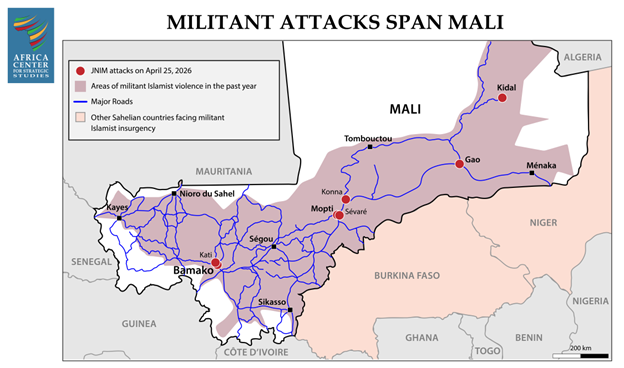
The coordinated attacks that shook Mali between April 25 and 27, 2026, were not an anomaly; they were a stark, brutal culmination of a long, deteriorating security trajectory that has steadily eroded state authority, exposed strategic miscalculations, and now threatens to overwhelm national and regional security architectures. At the heart of this crisis lies a troubling reality: Mali is no longer facing a fragmented insurgency. It is confronting an adaptive, coordinated, and increasingly convergent threat ecosystem – one that is evolving faster than the institutions designed to counter it.
A Decade of Decline: The Roots of Mali's Instability
The current security predicament in Mali is deeply rooted in a decade of political instability and mismanaged transitions. The 2012 Tuareg rebellion and subsequent jihadist takeover of the north marked a critical turning point, shattering the illusion of state control and opening a Pandora's Box of challenges. While international interventions, notably France's Operation Serval and later Barkhane, provided temporary relief, they failed to address the underlying governance deficits, ethnic grievances, and socio-economic marginalization that fuel recruitment into extremist groups. The withdrawal of French forces and the subsequent pivot towards Russia, epitomized by the Alliance of Sahel States (AES), have introduced new dynamics but have yet to deliver a decisive shift in the security landscape.
Crucially, the April 2026 attacks underscore a significant evolution in the operational capabilities of various armed groups. What was once perceived as a collection of disparate entities – Al-Qaeda-affiliated Jama'at Nusrat al-Islam wal Muslimeen (JNIM), Islamic State in the Greater Sahara (ISGS), and various ethnic militias – now appears to be a more interconnected and strategically aligned force. This convergence allows for simultaneous pressure on multiple fronts, stretching the already thin resources of the Malian Armed Forces (FAMa) and their allies. The attacks on key military installations, supply routes, and even urban centers demonstrate a sophisticated intelligence network and a capacity for complex logistical planning previously underestimated.
The Converging Threat: Beyond Fragmented Insurgency
Recent analysis indicates that the April 2026 attacks are a clear signal of a converging threat ecosystem. This means that groups like JNIM and ISGS, despite their ideological differences and occasional clashes, are increasingly finding common ground or at least tacit coordination in their efforts to destabilize the Malian state. This convergence is not necessarily a formal alliance but rather a strategic alignment of interests, where the collective impact of their actions far exceeds the sum of individual attacks. They exploit the state's weaknesses – its limited reach outside urban centers, its struggles with corruption, and its often-strained relationship with local populations – to expand their influence and control.
This evolving threat is characterized by several key features: * Geographic Expansion: Insurgent activities are no longer confined to the northern and central regions but are encroaching upon the south, threatening the capital Bamako and vital economic arteries. * Targeting State Symbols: Direct assaults on military bases, administrative buildings, and symbols of state authority aim to undermine public confidence and demonstrate the government's inability to protect its citizens. * Information Warfare: Alongside kinetic operations, these groups are increasingly sophisticated in their use of propaganda and social media to spread their narrative, recruit new members, and sow discord. * Economic Disruption: Attacks on markets, transportation routes, and agricultural areas aim to cripple local economies, exacerbating poverty and creating fertile ground for recruitment.
The implications of this convergence are profound. It suggests a future where the Malian state faces a multi-faceted challenge that cannot be addressed by purely military means. The erosion of state authority is not just about territorial control; it's about the loss of legitimacy and the inability to provide basic services, justice, and security to its population.
Strategic Miscalculations and the AES's Test
The Malian government's strategic choices in recent years have inadvertently contributed to the current predicament. The decision to expel French forces and the UN peacekeeping mission (MINUSMA), while framed as a move towards greater sovereignty, created a significant security vacuum. The subsequent reliance on Russian military contractors, while providing some tactical advantages, has not fundamentally altered the strategic balance or addressed the root causes of the insurgency. Furthermore, the Alliance of Sahel States (AES) – comprising Mali, Burkina Faso, and Niger – is still in its nascent stages and faces immense challenges in coordinating a unified, effective response across vast, porous borders.
The April attacks represent a critical test for the AES. Its ability to respond swiftly, decisively, and collectively will determine its credibility and long-term viability. The attacks also highlight the limitations of a purely military-centric approach. While counter-terrorism operations are necessary, they must be coupled with robust governance reforms, inclusive political processes, and targeted development initiatives that address the grievances driving the insurgency. Without a comprehensive strategy that tackles both the symptoms and the causes of instability, the cycle of violence is likely to persist and intensify.
The Regional Ripple Effect and International Neglect
Mali's crisis is not an isolated phenomenon; it has significant regional implications. The destabilization of Mali directly impacts its neighbors, particularly Burkina Faso and Niger, which are also grappling with their own insurgencies and political transitions. The spillover effect of violence, displacement, and extremist ideologies threatens the entire Sahel region and could potentially reach coastal West African states. The humanitarian crisis is already dire, with millions displaced and facing severe food insecurity, further straining regional resources and creating new vulnerabilities.
From an international perspective, there's a growing concern about the perceived neglect of the Sahel crisis. While global attention is often drawn to other geopolitical hotspots, the slow-burning catastrophe in Mali and the broader Sahel continues largely unabated. The shift in alliances, particularly Mali's closer ties with Russia, has complicated traditional diplomatic and aid channels, leaving a void that extremist groups are eager to fill. A renewed, coordinated international effort – one that respects national sovereignty but offers genuine partnership in governance, development, and security sector reform – is desperately needed to prevent a complete collapse.
Conclusion: A Precarious Future Demanding Comprehensive Solutions
The coordinated attacks of April 2026 serve as a stark warning: Mali is at a critical juncture. The state's fragility has been laid bare, and the evolving, converging threat ecosystem poses an existential challenge. The government, alongside its AES partners, must move beyond reactive military responses and embrace a comprehensive strategy that prioritizes good governance, inclusive development, and genuine reconciliation. This means strengthening institutions, delivering justice, providing essential services, and fostering trust between the state and its citizens. Without such fundamental shifts, the cycle of violence will continue, deepening the humanitarian crisis and further destabilizing a region already on the brink. The path forward is arduous, but the alternative – a failed state in the heart of the Sahel – is a prospect too grim to contemplate. The international community, too, bears a responsibility to re-engage constructively, offering support that addresses the multifaceted nature of this complex crisis before it spirals beyond control.
Stay Informed
Get the world's most important stories delivered to your inbox.
No spam, unsubscribe anytime.
Comments
No comments yet. Be the first to share your thoughts!