Silent Sentinel: IIT Jammu's Undetectable Drone Revolutionizes Military Surveillance
Indian Institute of Technology Jammu researchers have unveiled a groundbreaking drone designed to be virtually undetectable and unjammable. By eschewing traditional radio frequencies, this innovation promises to significantly enhance military surveillance and combat capabilities, offering a stealth advantage unlike any other. This development positions India at the forefront of advanced drone technology, with profound implications for national security and defense strategies.
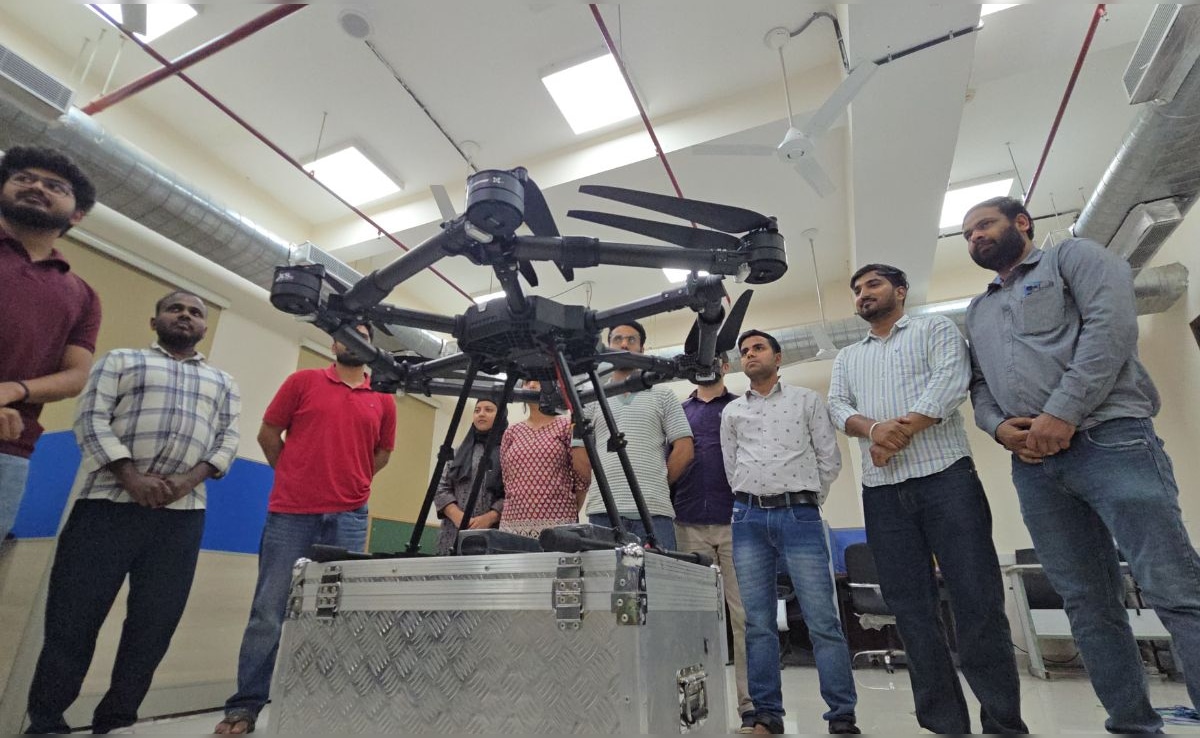
In a world increasingly defined by technological warfare and the relentless pursuit of strategic advantage, a silent revolution is brewing in the heart of India. Researchers at the Indian Institute of Technology (IIT) Jammu have engineered a drone that promises to redefine the paradigms of military surveillance and combat. This isn't just another drone; it's a game-changer, a sophisticated aerial vehicle designed to be virtually undetectable by enemy forces and immune to conventional jamming techniques. Its development marks a significant leap forward, not only for the Indian Army but for the global defense landscape, signaling an era where stealth and evasion become paramount.
The traditional Achilles' heel of modern drones lies in their reliance on radio frequencies, making them susceptible to detection, jamming, and interception. However, the IIT Jammu team, comprising brilliant minds like Dr. Karan Nathwani, Dr. Binod Kumar, and PhD scholar M. Dinesh, has ingeniously circumvented this vulnerability. Their innovation lies in a novel communication and navigation system that operates outside the conventional radio spectrum, rendering it invisible to standard electronic warfare countermeasures. This breakthrough could provide an unprecedented edge in reconnaissance, intelligence gathering, and precision strikes, fundamentally altering the calculus of military operations.
The Technological Leap: Beyond Radio Frequencies
The core of this drone's revolutionary capability lies in its non-radio frequency communication. While the specifics of the technology remain under wraps for national security reasons, experts speculate it could involve advanced optical communication, quantum entanglement principles, or highly sophisticated acoustic signatures combined with AI-driven evasion algorithms. "The ability to operate without emitting a detectable radio signature is the holy grail of stealth technology," explains Dr. Anya Sharma, a defense technology analyst. "This isn't just about avoiding jamming; it's about making the drone effectively invisible to the electronic eyes of the adversary. It forces opponents to rethink their entire air defense strategy, which is a massive tactical advantage."
Traditional drones, even those with low-observable features, can be tracked by their electromagnetic emissions. Jamming devices flood specific frequency bands with noise, disrupting communication and navigation. This new IIT Jammu drone, by contrast, seems to sidestep these issues entirely. Imagine a reconnaissance mission where the drone can penetrate deep into enemy territory, gather critical intelligence, and return without ever triggering an alarm or being electronically targeted. This capability dramatically reduces the risk to personnel and assets, making missions safer and more effective. Furthermore, the drone's immunity to jamming ensures mission continuity even in highly contested environments, a critical factor in modern warfare where electronic warfare plays a pivotal role.
Implications for Indian Defense and Global Security
The immediate beneficiary of this technology will undoubtedly be the Indian Army. With ongoing border tensions and the need for robust surveillance capabilities, this drone offers a strategic advantage. It can be deployed for: * Covert reconnaissance: Gathering intelligence on enemy movements, fortifications, and strategic assets without detection. * Target acquisition: Pinpointing high-value targets for precision strikes with minimal risk. * Border security: Monitoring vast and challenging terrains, especially in mountainous regions like the Himalayas, where traditional surveillance is difficult. * Counter-insurgency operations: Providing real-time intelligence in complex operational environments.
This development also places India firmly among the global leaders in advanced drone technology, a domain previously dominated by a handful of nations. "This isn't just an incremental improvement; it's a paradigm shift," states General (Retd.) Vikram Singh, a former Indian Army Chief. "It demonstrates India's growing prowess in indigenous defense innovation and reduces our reliance on foreign technology. The strategic implications are immense, both for defensive and offensive capabilities."
The global defense community will be watching closely. Nations heavily invested in electronic warfare capabilities will now face a new challenge, potentially sparking an arms race in counter-stealth technologies. The balance of power in regional conflicts could shift, favoring those with access to such advanced, undetectable platforms.
The Road Ahead: From Lab to Battlefield
While the announcement is significant, the journey from laboratory prototype to widespread battlefield deployment is often long and arduous. Testing in diverse operational environments, scaling up production, and integrating the drone into existing military command and control structures will be crucial next steps. The researchers have reportedly conducted successful trials, demonstrating the drone's stealth capabilities. However, real-world scenarios present far greater complexities.
Funding and governmental support will be vital to accelerate this process. The 'Make in India' initiative, aimed at boosting indigenous manufacturing and innovation, provides a strong framework for such projects. Collaborations between IIT Jammu, defense public sector undertakings, and private defense manufacturers will be key to rapidly deploying this technology. Training personnel to operate and maintain these sophisticated systems will also be a significant undertaking.
Moreover, the ethical considerations surrounding autonomous and stealthy weapons systems will need to be addressed. As drones become more sophisticated and less detectable, the discussions around their use, accountability, and potential for unintended escalation will intensify on the international stage.
Conclusion: A New Era of Asymmetric Warfare
The IIT Jammu drone represents more than just an engineering marvel; it symbolizes a new era of asymmetric warfare where technological superiority can dramatically alter the battlefield. By rendering traditional detection and jamming methods obsolete, this drone offers a profound tactical advantage, potentially saving lives and ensuring mission success in high-risk environments. It underscores India's commitment to self-reliance in defense and its growing capacity to innovate at the cutting edge of global technology.
As the world grapples with evolving geopolitical landscapes and complex security challenges, innovations like the IIT Jammu drone will be instrumental in shaping the future of defense. It's a testament to the ingenuity of Indian scientists and engineers, promising a future where the silent sentinel watches over national interests, unseen and unheard, a true guardian of the skies.
Stay Informed
Get the world's most important stories delivered to your inbox.
No spam, unsubscribe anytime.
Comments
No comments yet. Be the first to share your thoughts!