Trump's Divine Imagery: Decoding the Political Theology of AI-Generated Messiahs
Former President Donald Trump's recent reposting of an AI-generated image depicting him in a spiritual embrace with Jesus has ignited a fresh wave of controversy and analysis. This incident follows a pattern of religiously charged rhetoric and imagery from Trump, prompting questions about the intersection of faith, politics, and digital manipulation. Experts are examining the strategic implications of such visuals in mobilizing a specific voter base and the broader impact on religious discourse within the political arena.
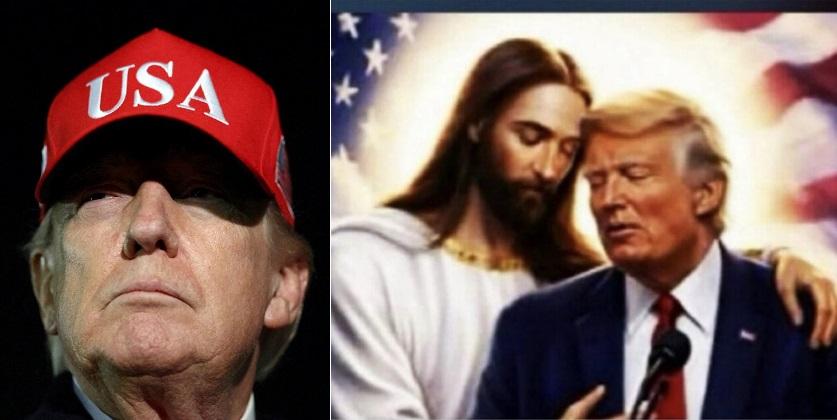
In an era where digital imagery blurs the lines between reality and fabrication, former U.S. President Donald Trump has once again found himself at the epicenter of a swirling controversy, this time involving an AI-generated image of profound religious significance. The picture, reposted to his Truth Social account, depicts Trump with his eyes closed, in a seemingly intimate, temple-to-temple embrace with a similarly posed Jesus Christ. This latest digital artifact has not only reignited debates about the ethics of AI in political communication but also underscored Trump's long-standing, often provocative, engagement with religious symbolism.
The Digital Messiah: A Pattern of Provocation?
The image surfaced just two days after Trump had deleted a previous post that drew widespread criticism for seemingly comparing himself to Jesus. While the earlier post was swiftly removed, the new image, though not directly posted by Trump but rather reposted from another account, carries a similar, if more subtly implied, message of divine endorsement. The visual narrative presented is one of spiritual connection, suggesting a personal, almost sacred, bond between the former president and a central figure of Christianity. This isn't an isolated incident; throughout his political career, Trump has frequently invoked religious themes, often positioning himself as a defender of faith and traditional values, a strategy that has resonated deeply with a significant segment of his evangelical Christian base.
Artificial intelligence (AI) generated content has become a powerful, albeit ethically complex, tool in the political landscape. From deepfakes to hyper-realistic imagery, AI offers unprecedented capabilities for crafting narratives and influencing public perception. The use of such technology in this context raises critical questions about authenticity, manipulation, and the responsibility of public figures in disseminating content that could be misconstrued as factual or divinely sanctioned. The ease with which these images can be created and shared means that discerning truth from fiction becomes an increasingly challenging task for the average citizen, potentially eroding trust in media and political discourse.
Historical Echoes: Religion and American Politics
The intertwining of religion and politics is a deeply ingrained feature of American history, dating back to the nation's founding. From the Puritan settlers' vision of a 'city upon a hill' to the moral crusades of the 19th century and the rise of the Christian Right in the late 20th century, religious belief has consistently shaped political movements and presidential campaigns. Figures like Abraham Lincoln, known for his profound spiritual reflections during the Civil War, and Jimmy Carter, an openly devout Baptist, have all navigated the complex relationship between their faith and their public office. However, Trump's approach often appears less about personal piety and more about strategic alignment, leveraging religious iconography and rhetoric to consolidate support.
Historically, presidents have often used religious language to inspire, unify, or justify policy. Ronald Reagan frequently invoked divine providence, and George W. Bush spoke openly about his faith guiding his decisions. What distinguishes Trump's use of religious imagery, particularly in this instance, is the direct, almost literal, visual association with Jesus Christ, bypassing traditional intermediaries of religious authority. This direct appeal to a divine connection can be seen as a powerful tool for mobilizing voters who view him as a divinely appointed leader or a champion of their religious values against perceived secular threats.
Expert Analysis: The Strategic Calculus of Sacred Imagery
Political strategists and religious scholars alike are dissecting the implications of Trump's latest post. Dr. Sarah Jenkins, a professor of political communication at Georgetown University, notes, "This isn't just about a picture; it's about a highly calculated political maneuver. Trump understands the deep emotional and spiritual resonance of such imagery for his base. It reinforces a narrative of persecution and divine mission, positioning him as a savior figure against perceived enemies." She adds that the use of AI allows for the creation of perfectly tailored visuals that might otherwise be impossible or too controversial to stage with real people.
Furthermore, the timing of such posts is rarely coincidental. As the 2024 election cycle intensifies, Trump's campaign is actively working to energize his core supporters. Religious imagery serves as a potent rallying cry, reinforcing loyalty and commitment. For many evangelical Christians, who constitute a significant voting bloc, the perception of a leader who shares or embodies their faith is paramount. The image, regardless of its AI origin, taps into a powerful narrative of spiritual warfare and divine intervention, themes deeply embedded in certain evangelical traditions.
However, this strategy is not without its risks. Critics argue that such imagery can be seen as blasphemous, self-aggrandizing, and an inappropriate conflation of religious faith with political ambition. Mainstream religious leaders and secular commentators often express concern that such tactics dilute the sanctity of religious figures and contribute to a form of political idolatry. The potential for alienating moderate voters or those who find such displays distasteful is also a factor, though Trump's past actions suggest he often prioritizes energizing his base over appealing to broader demographics.
The Future of Faith, AI, and Politics
The incident serves as a stark reminder of the evolving landscape of political communication, where technology and deeply held beliefs intersect in unprecedented ways. As AI tools become more sophisticated and accessible, the challenge of distinguishing between authentic and fabricated content will only grow. For citizens, developing media literacy skills to critically evaluate digital content will be crucial. For political figures, the ethical boundaries surrounding the use of AI-generated religious imagery will undoubtedly continue to be tested.
Looking ahead, the implications extend beyond the immediate political cycle. The normalization of AI-generated religious iconography in political campaigns could fundamentally alter how faith is perceived and utilized in the public square. It raises questions about the commercialization of sacred symbols, the potential for spiritual manipulation, and the erosion of traditional religious authority. As PulseWorld continues to monitor these developments, one thing is clear: the intersection of technology, religion, and power will remain a fertile ground for both profound connection and profound controversy, shaping the future of global politics in ways we are only just beginning to comprehend. The digital embrace between Trump and Jesus, whether perceived as divine inspiration or cynical manipulation, is a potent symbol of our complex times.
Stay Informed
Get the world's most important stories delivered to your inbox.
No spam, unsubscribe anytime.
Comments
No comments yet. Be the first to share your thoughts!